Editorials The Beautiful Game: How Hyundai Motor and Boston Dynamics Taught a Robot to Play Football
Please use Safari to download the files.
It takes more than code to bend it like a pro. Inside the groundbreaking AI training that taught Atlas® the beautiful game and unlocked the next generation of humanoid agility.
It feels like a scene straight out of a sci-fi blockbuster, but it is entirely real.
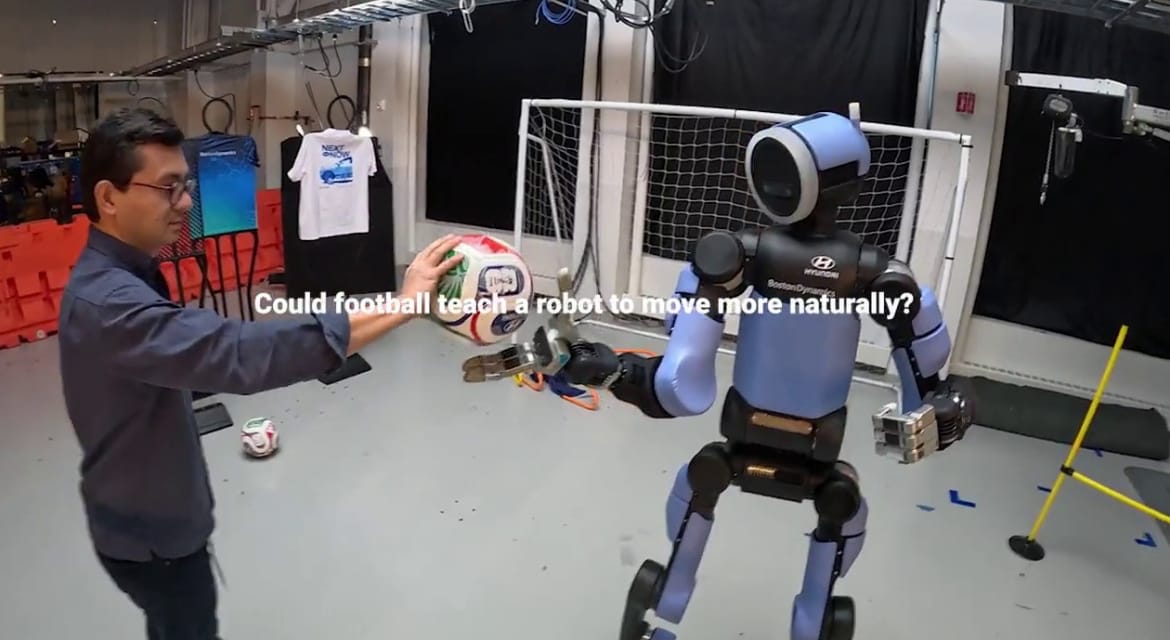
In a new video from Hyundai Motor Company, Boston Dynamics humanoid robot Atlas flawlessly executes a series of complex football (soccer) drills. It dribbles, passes and shoots with human-like agility. The sequence culminates in a stunning ‘Ghost Rabona,’ a sophisticated move involving a feint and a cross-legged kick that would challenge even top professionals.
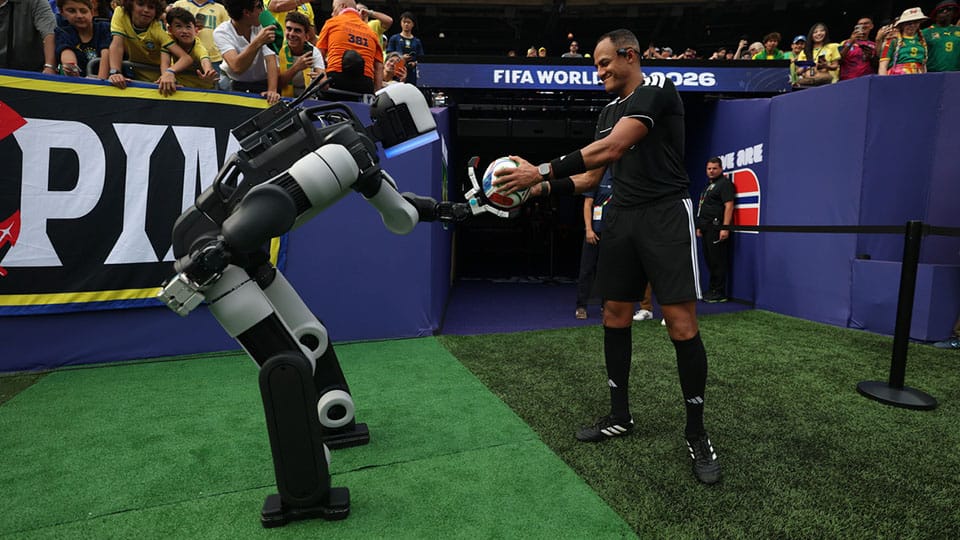
This display of robotic athleticism, part of Hyundai Motor’s ‘School of Football’ campaign, has left viewers around the world in awe. While the headline might be about a robot playing football, the real breakthrough is teaching a machine to learn and move in the most natural way possible.
Under its ‘Next Starts Now’ FIFA World Cup 2026™ platform, the campaign uses football as a universal language to explore human-centered robotics through emotion and storytelling. The heart of the campaign is a five-part episodic social film series released in late May across Hyundai Motor’s global channels, following Atlas’s journey from curious observer to mastering the pitch. To connect the story directly to the global football community, Hyundai Motor also released a special reaction video featuring global brand ambassador and football superstar Son Heung-min.
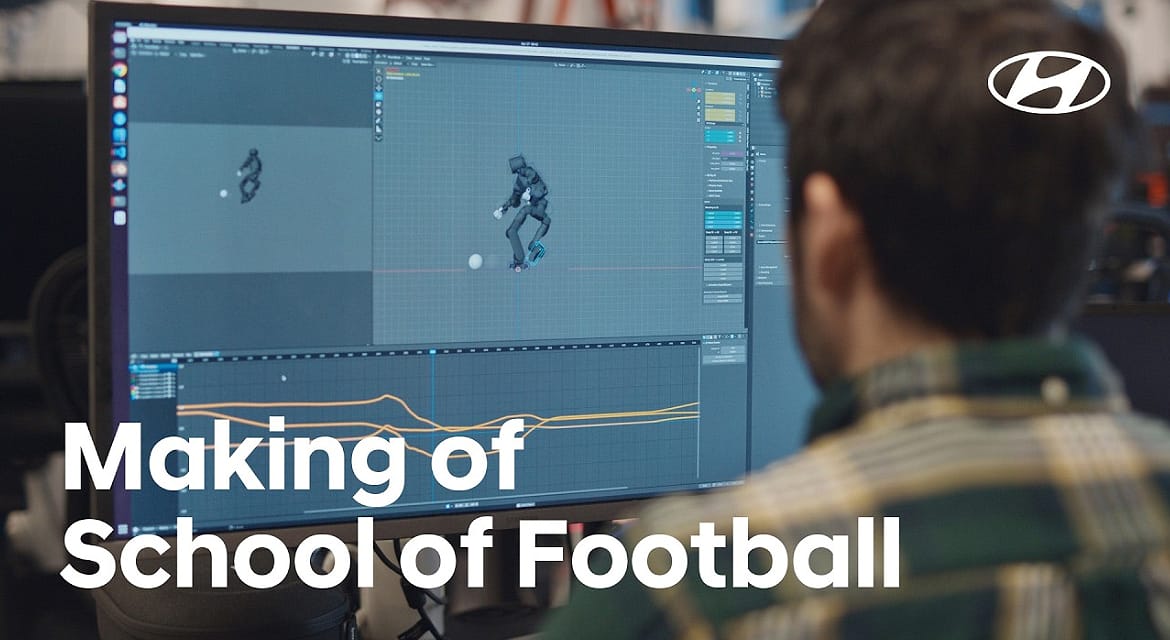
But how exactly do you teach a machine to bend it like a pro? On June 4, Hyundai Motor and Boston Dynamics answered that question. Taking fans beyond the seamless marketing performance, Hyundai Motor released a making-of film documenting the rigorous development process, while Boston Dynamics published a deep dive into the engineering and training methodologies.
For the engineers at Boston Dynamics, the challenge was clear: how do you make a robot move with the same dynamism and fluidity as a human athlete? The answer, it turned out, was to go back to school — the ‘School of Football.’
Why choose football as the training ground for one of the world’s most advanced humanoid robots? The decision was rooted in science. Boston Dynamics researchers explained that for a humanoid robot to achieve truly natural and versatile movement, it must master four interconnected abilities simultaneously: balance, timing, coordination and adaptation.
During a football match, all these skills are tested at once. Unlike many activities that separate movement from manipulating objects, football demands both in a constant, dynamic interplay. A player must continuously adjust their balance while running, perceive a moving object (the ball), and then execute a precisely timed and coordinated strike with their feet.
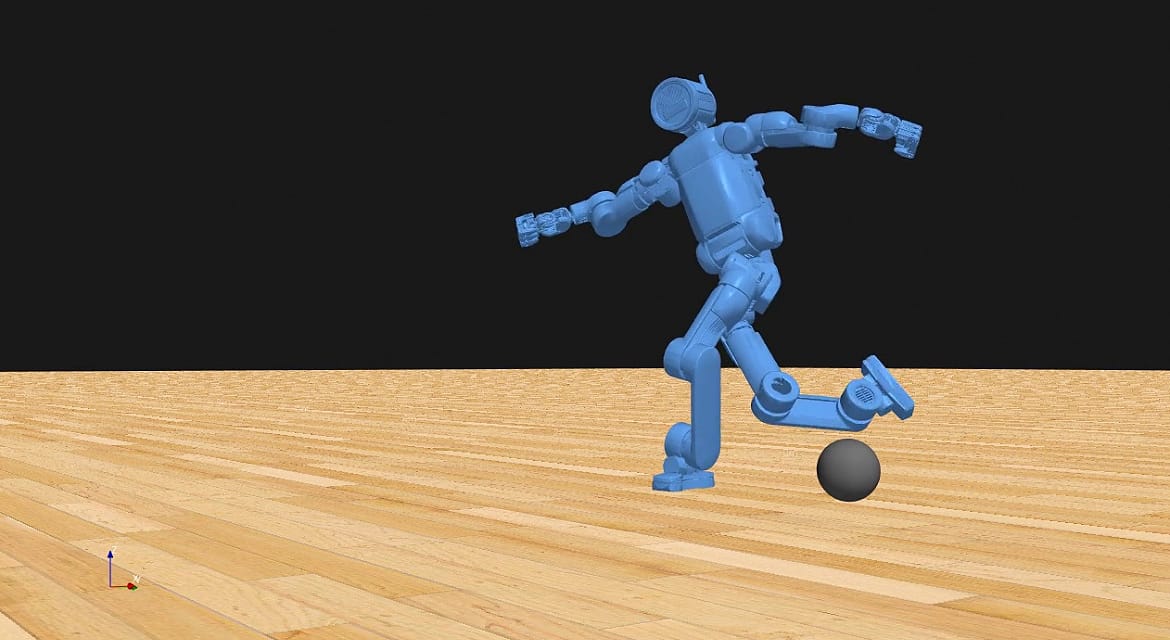
Kicking a ball may seem simple to us, but for a robot, it represents an immense challenge. It must perceive the ball’s location, move to the correct position, maintain its balance on one leg, and swing the other with the right amount of force and accuracy. This complex sequence requires a level of cognitive and control capability far beyond simply repeating pre-programmed motions. It was, as the research team identified, the perfect environment to teach Atlas the art of whole-body control.
The journey began not with code, but with people. To teach Atlas to move like a footballer, the team first needed a reference. Using a high-fidelity optical motion capture system — the same technology used in blockbuster films and video games — they recorded the movements of a professional football player. Decked out in a suit covered with reflective markers, the player performed a range of actions, from basic kicks and passes to the highly complex ‘Ghost Rabona.’
This process provided a rich dataset of human movements. In a move that highlights the team’s hands-on approach, Roberto Shu, a senior research engineer at Boston Dynamics, also put on the motion capture suit himself. Many of the fundamental drills and kicks that Atlas learned were based on his own movements, adding a personal touch to the robot’s training. This method of learning directly from human demonstrations is a significant leap forward in robotics. It transforms what was once a painstaking process of manually programming every joint and movement into a more intuitive task of showing the robot what to do.
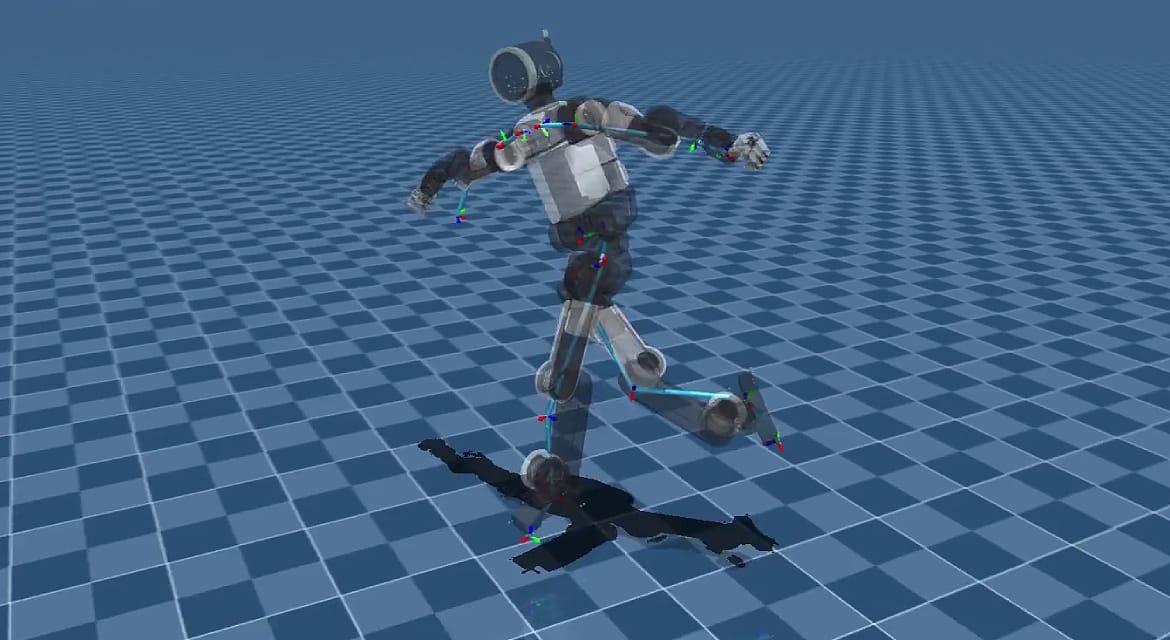
However, simply copying human motion is impossible. This is where the first major hurdle appears. While Atlas is humanoid in form, its physical structure is fundamentally different from a person’s. Its joints have different ranges of motion, its limbs have different proportions, and its center of gravity is unique. A direct one-to-one mapping of the human player’s movements would result in awkward, unstable or physically impossible actions for the robot.
The solution is a critical process called ‘retargeting.’ This is where the captured human motion data is intelligently translated to fit Atlas’s specific body. It’s a sophisticated digital tailoring process, where algorithms remap the movements to the robot’s kinematics, ensuring that the essence and style of the action are preserved while adhering to the robot’s physical constraints. This step is the essential bridge between human inspiration and robotic execution, allowing Atlas to perform moves that look and feel like a human’s, but are achievable within its own mechanical reality.
With a reference trajectory established through retargeting, the real learning could begin. The team employed a widely used artificial intelligence (AI) technique called reinforcement learning (RL). Through RL, the robot learns through trial and error — much like a human does — instead of being explicitly programmed.
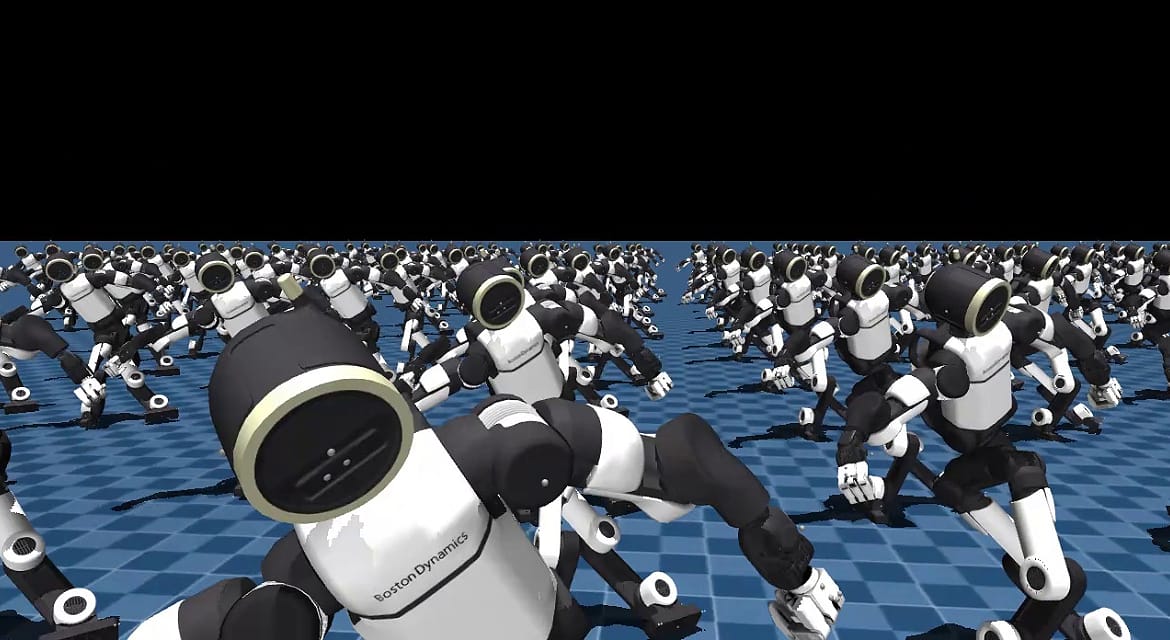
However, this process doesn’t happen with the physical Atlas robot as it would be too slow and risky. Instead, Atlas learns in a vast, cloud-based simulated environment, where it can repeatedly practice the football movements at scale. Within this environment, the RL system rewards actions that successfully mimic the retargeted human motion while maintaining balance and control. Over time, through countless attempts, the system learns not just the motion itself, but the underlying physics of how to achieve it. It figures out the precise motor controls, the distribution of weight, and the forces needed to swing a leg, plant a foot, and stay upright.
The scale of this virtual training is staggering. By running thousands of simulations in parallel on cloud GPUs, the team could condense the learning process exponentially. In just 24 hours, Atlas could experience the equivalent of a full year’s worth of physical trial and error. This massive, parallel learning allows the robot to rapidly master complex movements that would have been impossible to program by hand.

The true test, of course, comes when the learned behavior is deployed on the physical Atlas robot. After the intensive simulation training, the resulting control policy — the system that governs how the robot executes the skill — was deployed on the real-world Atlas. In a testament to the power of the simulation and learning process, the team found that for nearly all of Atlas’s football skills, the policy worked perfectly on the very first try.
This seamless transfer from simulation to reality is a major challenge in robotics. The fact that Atlas could execute a complex kick flawlessly on its first physical attempt demonstrates the quality of the simulation and the effectiveness of the reinforcement learning approach. In cases where minor errors did occur during physical testing, that data was fed back into the training loop, allowing the system to learn from its mistakes and continuously improve its performance.
The crown jewel of Atlas’s football performance is the ‘Ghost Rabona.’ This isn’t just a rabona — a move where the kicking leg is wrapped around the back of the standing leg. The ‘Ghost’ element adds a feint, a fake-out step-over designed to deceive a defender. For a robot, this move is a monumental challenge. It requires a rapid change of direction for the feint, a powerful jump to get both feet off the ground, a stable landing, and the immediate execution of a forceful kick, all while maintaining dynamic balance.
This single, fluid sequence pushes the limits of the robot’s physical intelligence. It’s a symphony of whole-body control, where every joint, from the ankles to the torso and arms, must work in perfect harmony. Successfully performing the ‘Ghost Rabona’ is not just a flashy trick; it’s a rigorous test of the robot’s ability to manage momentum, generate power, and coordinate its entire body as a single, integrated system.
While teaching a robot to play football is an inspiring achievement, the project’s ultimate goal extends far beyond the pitch. The skills Atlas learned are directly transferable to practical, real-world applications. The whole-body coordination required to kick a ball reflects underlying capabilities that are also important for tasks such as lifting and carrying objects in a warehouse, navigating a cluttered factory floor, or performing complex manipulation tasks in industrial settings.
By mastering an activity that combines locomotion and manipulation, Atlas is developing broader capabilities that can support a wide range of industrial application. The lessons learned in timing, force generation, and dynamic balance through tasks like these are crucial for advancing humanoid robots that can move naturally and gracefully. Meanwhile, complex drills develop the robots’ rotational movement, weight shifting capabilities, and body control, making them safer and more effective when working with humans. This project shows that thinking — and training — outside the box is key to unlocking the next generation of robotics.
The collaboration between Hyundai Motor and Boston Dynamics is a glimpse into the future. It’s a world where robots are not just programmed but taught, where they can learn from us to move with a level of agility and intelligence that was once the exclusive domain of humans. The ‘School of Football’ has graduated its first robotic student, and its lessons are set to redefine what is possible in the world of work, automation and beyond.
The ‘School of Football’ series is just one piece of Hyundai Motor’s massive ‘Next Starts Now’ platform for the FIFA World Cup 2026™. The campaign is anchored by a 60-second global cinematic film airing in 180 countries, which pairs football icon Son Heung-min and the Atlas robot with five real-world, rising football prodigies — including Da’vian Kimbrough and Stella Spitzer — to show how the next generation of talent is shaping the future today.
Beyond the screen, the platform extends into real-world fan engagement, featuring youth soccer camps across the U.S. hosted by legends like Mia Hamm and Tim Howard, immersive tech-driven Fan Festival activations in major host cities across North America, the FIFA Museum’s ‘Legacies of Champions’ exhibition at Rockefeller Center, and the fan-driven ‘Be There With Hyundai’ National Team Bus campaign.
More information about Atlas’s training can be found on the Boston Dynamics blog: https://bostondynamics.com/blog/can-football-teach-a-robot-to-move
Videos of Hyundai Motor’s latest FIFA World Cup 2026™ campaigns can be found on the company’s official YouTube channel: https://www.youtube.com/@HyundaiWorldwide
Seoyong Choi
seoyong.choi@hyundai.com
Global PR Team 1 · Hyundai Motor Company
Disclaimer: Hyundai Motor Group believes the information contained herein to be accurate at the time of release. However, the company may upload new or updated information if required and assumes that it is not liable for the accuracy of any information interpreted and used by the reader.
About Hyundai Motor Group
Hyundai Motor Group is a global enterprise that has created a value chain based on mobility, steel, and construction, as well as logistics, finance, IT, and service. With about 250,000 employees worldwide, the Group’s mobility brands include Hyundai, Kia, and Genesis. Armed with creative thinking, cooperative communication and the will to take on any challenges, we strive to create a better future for all.
More information about Hyundai Motor Group can be found at: http://www.hyundaimotorgroup.com or Newsroom: Media Hub by Hyundai, Kia Global Media Center (kianewscenter.com), Genesis Newsroom