

Breaking down EV charging: Types, networks and the road ahead.
Australia’s Electric Highway.
An extensive EV charging station network is the key to a sustainable future on Aussie roads. Thankfully, Australia already has a growing network of public charging stations, so drivers can conveniently and confidently switch to electric vehicles.
According to the Electric Vehicle Council, as of 2024, there were already more than 1,800 high power public charging stations a number that has only grown since highlighting the nation’s ongoing commitment to expansion. In fact, Queensland has the world’s longest EV charging network in a single state, with Western Australia a close second and other states quickly catching up with their own electrification master plans.
With that in mind, let’s explore how EV charging works, the different charging options owners have, and how Hyundai is doing its part in supporting clean mobility.
How to charge an electric vehicle?
Level 1 Chargers (AC charging)
This involves charging your EV from a standard 120-volt household wall outlet. This is the simplest and slowest form of home EV charging, generally adding about 10–20 km of range per hour. Keep in mind, though, that factors like your car’s efficiency, battery size, and driving conditions can significantly affect the range. While these chargers are affordable and convenient, the actual range you’ll get overnight typically around 100-200 km will depend on those same factors.
Simply plug the charger into a regular wall outlet and connect the other end to your EV’s charging port charging will begin automatically. Many EVs allow you to monitor progress through an app. This setup is ideal for topping up your vehicle overnight at home.

Level 2 chargers (AC charging)
Home wall boxes are commonly installed in household garages, apartment parking areas, or at public charging locations such as shopping centres and workplaces. For residential use, single-phase Level 2 chargers are typically used, adding around 30–35km of range per hour. Commercial settings often rely on three-phase Level 2 chargers, which can add 30–130km per hour.
However, it’s important to note that actual range depends on the vehicle’s efficiency, and achieving the higher end of that range would require both a high-amperage charger and a car capable of accepting that level of charge.
Level 2 public chargers can be located using charging station location apps like PlugShare. Activate the charger by tapping an RFID card or using a mobile app, and begin the session by connecting the charger to your EV’s port. Charging status is often displayed on the charger or in the app.

Level 3 chargers (DC fast charging)
These chargers provide rapid charging by converting AC power to DC within the charging station, bypassing the vehicle's onboard charger. They can deliver up to 150-300km of range per hour.
To find a DC fast-charging station, use a charging station location app. Activate the charger through an app or payment system, plug the fast charger into your EV’s DC charging port, typically located near the regular charging port, and the charger will handle the process automatically. Fast chargers are typically pay-per-use.
Charging times can vary based on factors like battery capacity, vehicle acceptance rate, and current charge level. Additionally, not all EVs are compatible with all Level 3 chargers, so it's essential to check your vehicle's specifications.

EV charger installation.
Getting set up for home charging is easy with Hyundai’s recommended providers, who can handle the installation seamlessly.
EV charging station growth in Australia.
Australia’s EV infrastructure is rapidly expanding, with over 1,000 fast-charging EV charging locations nationwide, according to the Electric Vehicle Council.
Queensland’s Electric Super Highway, introduced in 2017, is a clear example of Australia’s commitment to cleaner mobility. Stretching over 2,000 kilometers and offering a network of fast chargers, it allows drivers to traverse the state with shorter charging stops and greater convenience, setting a standard for future EV infrastructure.
Hyundai has been a key contributor to this expansion, working with partners to help Australia meet its EV adoption goals by supporting new charging stations and improving EV accessibility. Today, finding an EV charging station has never been easier.
Recently, we sent a team to test this charging network, taking the IONIQ 5 N and KONA Electric on a cross-country road trip from Perth to Sydney. Helped by their maximum ranges of 505km and 488km, both cars made it from station to station with ease. You can re-trace their trip yourself.
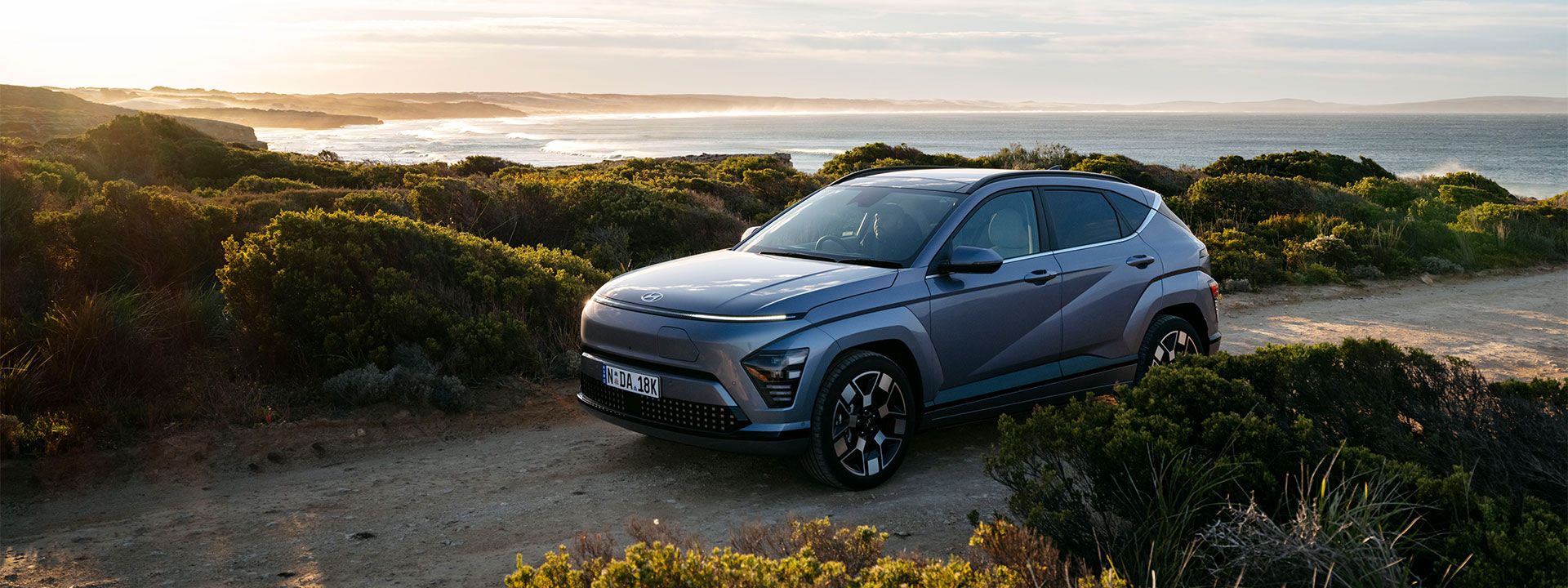
Hyundai fast charging: Less waiting, more driving.
We’ve designed our EVs to make charging simple and stress-free. Models like the IONIQ5, IONIQ 6, IONIQ 5 N, and KONA Electric come with advanced features that take the hassle out of powering up. With ultra-fast charging, you can go from 10% to 80% in just 18 minutes using a 350kW fast charger*, perfect for a quick break while you grab a coffee.
To make life even easier, Hyundai offers a range of EV charging cables and genuine accessories, so you’re always ready to power up, whether at home, at work, or on the go.
And with Hyundai’s innovative Vehicle-to-Load (V2L) technology, your EV isn’t just a car; it’s a portable power source. You can plug in appliances, charge your devices, or even power camping gear, giving you more freedom wherever the road takes you.
From daily commutes to weekend adventures, Hyundai EVs fit seamlessly into your lifestyle, making every charge simple and convenient.
*Charging times may vary based on charger specifications, battery condition, and ambient temperature, and may be longer if peak charging rates are not achieved.
Hyundai’s Electrification Strategy: Our commitment to EV innovation.
We’re at the forefront of innovation in EV charging. Our strategy focuses on driving real change by making EVs accessible for more Australians through partnerships, public charging support, and other initiatives.
This includes growing our BEV (Battery Electric Vehicle) line-up, optimising manufacturing capacity, and maintaining our position as a leader in hardware and software advancements.
The future of EV charging.
The future of EV charging in Australia is faster, smarter, and greener. Innovations like ultra fast chargers are already here, while further advancements like renewable energy integration and autonomous charging technology are on the horizon.
As Scott Nargar, Senior Manager of Future Mobility and Government Relations, puts it: “Australia is at the precipice of an EV revolution, and at Hyundai, we want to get more Australians behind the wheel of an EV than ever before.”
Hyundai is shaping this future, making charging convenient wherever the road takes you.

Ever driven an EV?
FAQs.
-
Charging time varies by charger type. With a fast charger, models like the IONIQ 5, IONIQ 6, IONIQ 5 N and KONA Electric can go from 10% to 80% in just 18 minutes*.
*Charging times may vary based on charger specifications, battery condition, and ambient temperature, and may be longer if peak charging rates are not achieved.
-
Charging an EV is easy. Start by locating the charging port, typically near the front or side of your vehicle, and connecting the appropriate cable for your charger type (home, public, or fast). Once connected, the system will automatically begin charging and display the progress on your vehicle’s dashboard or app.
For home charging, ask an expert to see if the setup is compatible with your household electricity supply. Public chargers may require an app or card to activate, while fast chargers are designed for quick top-ups during longer trips.
-
Charging frequency depends on how much you drive, but keeping the battery between 20% and 80% is typically best for longevity. You might charge daily, every two days, or every three days, depending on your driving habits.
-
Many public charging stations throughout Australia are free, especially in places like shopping centres or workplaces. However, for fast-charging stations, costs can range from $23 to $54 for a full charge, depending on the vehicle size, provider, time of day, and the kilowatt hours consumed. This is typically around 20% cheaper than refueling a petrol car.