What is a Hatchback Car? Features & Popular Models
Published: Aug 31, 2026
Choosing the right body style is one of the first steps when buying a car. Among all car types on Indian roads, the hatchback remains a popular choice for practical reasons. It offers a compact footprint, easy handling in tight spaces, and great functionality for daily commutes. Understanding what a hatchback car is helps buyers see why these cars suit new drivers and experienced urban commuters alike. Let us explore the design, key advantages, popular options, and features of hatchback cars in India.
Understanding a Hatchback Car?
A hatchback is a car body style with a rear door that swings upward to access the cargo area. Unlike traditional sedans that separate the boot space behind a fixed wall, a hatchback integrates the luggage compartment directly with the main passenger cabin. This design is often called a "three-door" or "five-door" layout, counting the top-hinged rear hatch as a full door.
The compact exterior measurements combined with an open interior layout create a versatile car. Foldable rear seats let owners expand storage space when they need extra capacity for family trips or shopping runs.
Key Features of a Hatchback Car
Hatchbacks offer specific practical design benefits that make them ideal for modern urban living.
Compact Design and Easy City Driving
A hatchback's short front and rear overhangs create a tight turning radius. Navigating narrow residential lanes, tight market streets, and crowded traffic spots becomes effortless. Parking in limited spaces is far easier compared to larger sedans or SUVs.
Practical Boot Space and Everyday Convenience
The upward-opening rear tailgate makes loading heavy bags, groceries, or luggage simple. Most hatchbacks feature 60:40 split rear seats or fold-flat bench seats. Folding the rear seats significantly increases cargo room for large items.
Fuel Efficiency and Low Ownership Cost
Hatchbacks are generally lighter than larger cars, which lets their engines deliver excellent fuel economy. Lower fuel consumption combined with affordable routine servicing makes them economical to buy and maintain over long ownership periods.
Comfort, Features and Safety
Modern hatchbacks come packed with high-end cabin technology and safety equipment. Dual digital displays, automatic climate control, touchscreen infotainment systems, wireless charging pads, 6 airbags, Electronic Stability Control (ESC), and rear parking cameras are widely standard across contemporary models.
Types of Hatchback Cars Available in India
The Indian hatchback market splits into distinct categories based on size, interior space, engine performance, and luxury offerings.
Small Hatchbacks
Small or entry-level hatchbacks focus on maximum fuel efficiency, affordability, and compact dimensions. They make ideal first cars for new drivers or small families who need efficient transport for daily city errands.
Premium Hatchbacks
Premium hatchbacks offer larger cabins, higher-quality interior materials, advanced safety features, and powerful engine options. They match the feature lists and comfort levels of mid-size sedans while retaining the easy parkability of a compact body style.
Why Choose a Hatchback Car?
A hatchback provides an ideal balance of practical everyday usability, low running costs, and stress-free driving.
● Easy Mobility: Light steering and compact dimensions make navigating congested city traffic smooth and hassle-free.
● Smart Space Usage: High rooflines provide generous headroom for all passengers, creating a spacious cabin environment despite the small exterior footprint.
● Budget Friendly: Affordable ex-showroom pricing and strong resale demand ensure excellent value for money.
Hyundai Hatchback Cars in India
Hyundai Motor India offers feature-packed hatchback options tailored for Indian driving conditions:
Hyundai Grand i10 NIOS
● Exterior: Sweptback projector headlamps, painted black radiator grille, LED DRLs integrated into the front bumper, LED tail lamps, and 15-inch diamond-cut alloy wheels.
● Interior: Dual-tone grey cabin layout, 8-inch touchscreen infotainment system, footwell lighting, premium seat upholstery, and leather-wrapped steering wheel.
● Safety: 6 airbags standard, Electronic Stability Control (ESC), Hill-Start Assist Control (HAC), Tyre Pressure Monitoring System (TPMS), and ISOFIX child seat anchors.
● Performance: 1.2L Kappa Petrol engine available with a 5-speed manual, Smart Auto AMT, or factory-fitted bi-fuel CNG option.
● Comfort & Convenience: Wireless phone charger, rear AC vents, tilt steering adjustment, engine start-stop button, and electric folding wing mirrors.
Hyundai i20
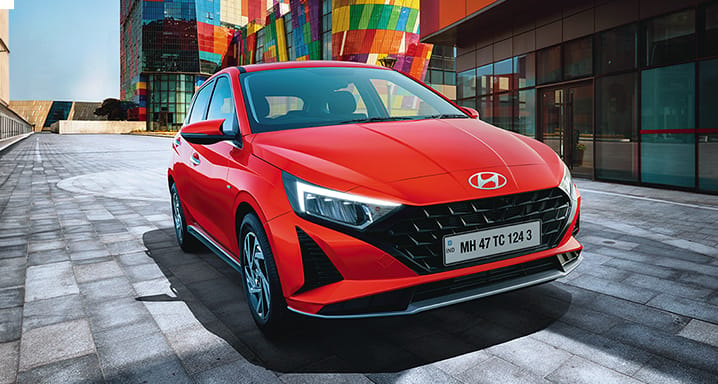
● Exterior: Parametric jewel pattern front grille, LED MFR headlamps, Z-shaped LED tail lamps, 16-inch diamond-cut alloy wheels, and shark fin antenna.
● Interior: Digital cluster with TFT multi-information display, 10.25-inch HD touchscreen display, ambient lighting, and leatherette seat upholstery.
● Safety: 6 airbags standard, Hill-Start Assist Control (HAC), rear parking camera with dynamic guidelines, Electronic Stability Control (ESC), and all-wheel disc brakes on select variants.
● Performance: Refined 1.2L Kappa Petrol engine mated to a 5-speed manual or a smooth Intelligent Variable Transmission (IVT).
● Comfort & Convenience: Voice-enabled smart electric sunroof, Bose premium 7-speaker sound system, sliding front armrest, climate control, and rear window sunshades.
Hyundai i20 N Line
● Exterior: Chequered flag-inspired front grille with Hyundai N Line logo, athletic red front bumper accents, red front brake callipers, side sill garnish, twin-tip sporty exhaust pipe, and 16-inch diamond-cut alloy wheels with N logo.
● Interior: All-black interior theme with red highlights and stitching, sporty leather-wrapped gear knob with N logo, 3-spoke leather steering wheel, and red ambient lighting.
● Safety: 6 airbags standard, Electronic Stability Control (ESC), Vehicle Stability Management (VSM), Hill-Start Assist Control (HAC), and 4-disc brakes for superior stopping power.
● Performance: 1.0L Turbo GDi Petrol engine delivering 120 PS power, available with a 6-speed manual or a lightning-fast 7-speed Dual Clutch Transmission (DCT) with paddle shifters.
● Comfort & Convenience: Voice-enabled smart electric sunroof, Bose 7-speaker sound system, drive modes, cruise control, wireless charging pad, and Hyundai Bluelink connected-car technology.
Conclusion
A hatchback car remains one of the most versatile, cost-effective, and user-friendly choices for car buyers in India. Its clever space layout, high fuel economy, and compact footprint make city driving stress-free. Whether you prefer the practical efficiency of the Grand i10 NIOS or the premium features and performance of the i20 range, Hyundai provides a model to suit every driving style.
Visit your nearest authorised Hyundai dealership today to explore our hatchback lineup. Book a test drive online to find the perfect car for your daily journey.
FAQs
Is a hatchback car safe for highway driving?
Yes, modern hatchbacks such as the Hyundai i20 and Hyundai GRAND i10 NIOS offer safety features designed to support highway driving. Depending on the variant, these can include 6 airbags, Electronic Stability Control (ESC), Hill-Start Assist Control (HAC), and a reinforced body structure. However, highway safety also depends on driving behaviour, road conditions and following speed limits.
What is the difference between a hatchback and a crossover?
A hatchback generally has a lower ride height and a compact passenger-car design, making it suitable for city driving. A crossover usually combines a car-like platform with higher ground clearance, a raised seating position and SUV-inspired styling. These features can make crossovers better suited to uneven roads while retaining the driving characteristics of a car.
Why do hatchbacks have a rear window wiper while sedans usually do not?
The more upright rear design of a hatchback can allow dust, water and road spray to collect on the rear glass while driving. A rear wiper helps maintain visibility in rain and dirty road conditions. Sedans generally have a more sloped rear windscreen, which can reduce the amount of spray reaching the glass, although some sedans may also offer rear wipers.
How much boot space does a typical hatchback offer?
Boot capacity varies considerably between hatchback models. Many compact and premium hatchbacks offer around 250 to 350 litres of space behind the rear seats. Folding the rear seats can increase the available luggage area, making it easier to carry larger items. Always check the manufacturer's stated boot capacity when comparing models.