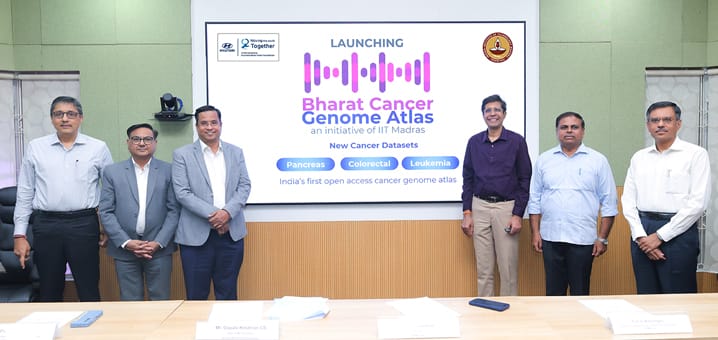
IIT Madras Releases First-of-Its-Kind Paediatric Leukaemia, Colorectal and Pancreatic Cancer Genome Database to Transform Cancer Research in India
With principal support from Hyundai Motor India under its flagship Hyundai Hope for Cancer initiative
A recent ICMR report indicates number of people living with this deadly disease continues to rise - National Cancer Registry Program reporting that one in nine people in India likely to develop cancer
The institute has made Bharat Cancer Genome Atlas (BCGA) publicly accessible at bcga.iitm.ac.in to researchers and clinicians in India and abroad
Bharat Cancer Genome Grid (BCG2)
Funding from Hyundai also includes support for cancer screening, awareness and treatment to low-income families
This assumes significance in the wake of World Cancer Day falling on 4th Feb 2026
Chennai | February 4, 2026: Cancer is one of the most fatal health problems globally. A recent Indian Council of Medical Research (ICMR) report indicated that number of people living with this deadly disease continues to rise.
The National Cancer Registry Program reported that one in nine people in India are likely to develop cancer in their lifetime and 2.5 million people were currently living with cancer. There is a 12.8% increase in cancer incidence every year since 2022.
Despite having a high cancer incidence, India has been under-represented in global cancer genome studies. In the absence of genomic architecture of cancers prevalent in India, specific genetic variants from Indian cancers are not adequately captured and catalogued for any diagnostic kits and drug development.
In order to fill the gap in genomic landscape for different cancers in India, IIT Madras initiated the Indian cancer genome program in 2020. Under this program, the whole genome sequencing from leukaemia, colorectal and pancreatic cancer patient samples collected across the country has been completed.
This research was enabled by Hyundai’s generous CSR support via the Hyundai Hope for Cancer program in line with the Hyundai Hope on Wheels initiative of Hyundai Motors India Limited. IIT Madras also partnered with Karkinos Healthcare, Mumbai, the KK Childs Trust Hospital, Chennai, Institute of Child Health, Chennai, Govt Rajiv Gandhi Hospital, Chennai, Kumaran Hospital, Chennai to analyse the data and assemble the anonymized summary of genetic variants from Indian leukaemia, colorectal and pancreatic cancer samples.
The Bharat Cancer Genome Grid (BCG2) is a clinician-centric national initiative designed to accelerate the responsible adoption of Whole Genome Sequencing (WGS) in routine oncology practice in India. Conceived as a functional and clinical adjunct to the Bharat Cancer Genome Atlas (BCGA), BCG2 aims to bridge the critical gap between large-scale cancer genome data generation and its meaningful application at the patient bedside.
The Research was led by the Institute’s Centre of Excellence on Cancer Genomics and Molecular Therapeutics, which was funded under the Government of India’s ‘Institutions of Eminence’ initiative and Hyundai Centre for Cancer Genomics with generous support on INR 56 Crores by Hyundai Motors India Foundation. The Centre focusses on genomic sequencing to identify genetic mutations, laying the foundation for a national paediatric leukaemia colorectal and pancreatic cancer genome database and personalized treatment protocols.
The centre, through this partnership actively conducts screening & vaccination camps, engages in upskilling of technicians and is involved in the deployment of mobile medical units to expand healthcare access to underserved regions. This partnership also includes INR 3 crores funds to support cancer treatment for the poor income families.
This assumes significance in the wake of World Cancer Day falling tomorrow (4th Feb 2026). Apart from this the centre also actively conducts screening & vaccination camps, engages in upskilling of technicians and is involved in the deployment of mobile medical units to expand healthcare access to underserved regions.
Prof. V. Kamakoti, Director, IIT Madras, announced the Indian cancer (leukaemia, colorectal and pancreatic) genome sequence generation and released on the campus today (4th Feb 2026).
The institute has made this database publicly accessible at bcga.iitm.ac.in to researchers and clinicians in India and abroad. Highlighting the benefits to not just India but the global research community from ‘Bharat Cancer Genome Atlas’, Prof. V. Kamakoti, Director, IIT Madras, said, “True to our ‘IITM for all’ commitment to society, we are releasing yet another genome data, the Leukaemia, Colorectal and Pancreatic Cancer Genome data. We hope that this will provide deep insights on reasons leading to this deadly disease and help preventing the same with early interventions. The Atlas fills the gap in genomic landscape from different cancers in the country. It provides a compendium of genetic variants representing the contemporary Indian leukaemia, colorectal and pancreatic cancer patients to classify variants involved in early diagnostics, disease progression, and treatment outcomes.”
Elaborating on this initiative, Project Coordinator Prof. S. Mahalingam, Head, Centre of Excellence on Cancer Genomics and Molecular Therapeutics and the Hyundai Centre for Cancer Genomics, IIT Madras, said, “This database will be an invaluable resource to identify cancer-specific biomarkers in India, which will enable early detection of paediatric leukaemia, colorectal and pancreatic cancers. Further, it will also be very useful to identify novel drug targets for developing better treatment strategies specific to the Indian population.”
“At Hyundai, our global vision ‘Progress for Humanity’ guides us to create meaningful impact beyond mobility. Through the Hyundai Hope for cancer program, we are committed to advancing equitable, technology driven cancer care for India. Our partnership with IIT Madras on the Bharat Cancer Genome Atlas and the Bharat Cancer Genome Grid reflects this commitment. By supporting genomic research, early detection, and access to treatment for underprivileged families, we aim to strengthen India’s foundation for precision oncology and bring hope to countless children and families impacted by cancer,” said Mr. Gopala Krishnan CS, Whole Time Director and Chief Manufacturing Officer – HMIL & Trustee, HMIF.
Further, Prof. S. Mahalingam, also a faculty in the Department of Biotechnology, IIT Madras, added, “BCGA also aims to host data from researchers working on cancer genomics across cancer types and would be open to accepting submissions. The data will be utilized towards identifying biomarkers to identify high-risk groups, monitor cancer progression, design strategies for personalized treatment and understand treatment outcomes.”
This Genome Atlas also provides knowledge on the genetic basis of cancer progression and evolution and may help the biomedical research and healthcare system in India shift toward a vision of “personalized medicine” which may improve the standard of medical care by including an individual’s genetic and molecular information in the clinical decision-making process.
BCG2 works in synergy with the BCGA aims to create ecosystem that empower oncologists, addressing population-specific genomic realities, and establishing unified frameworks for clinical implementation, BCG2 may ensure that the promise of precision medicine is translated into tangible benefits for cancer patients across India.
The analysis was performed under the aegis of National Center for Precision Medicine in Cancer, an initiative between IIT Madras and Karkinos Healthcare to accelerate interdisciplinary research and development of affordable cancer care solutions.
The Institute acknowledges the support from Hyundai Motors India and Department of Science and Technology, Ministry of Science and Technology, Government of India, for the Cancer Tissue Biobank facility at IIT Madras.
About IIT Madras:
Indian Institute of Technology Madras (IITM) was established in 1959 by the Government of India as an ‘Institute of National Importance.’ The activities of the Institute in various fields of Science and Technology are carried out in 18 academic departments and several advanced interdisciplinary research academic centres. The Institute offers undergraduate and postgraduate programmes leading to B.Tech., M.Sc., M.B.A., M.Tech., M.S., and Ph.D., degrees in a variety of specialisations. IITM is a residential institute with more than 650 faculty and 10,000 students. Students from 18 countries are enrolled here. IITM fosters an active entrepreneurial culture with strong curricular support and through the IITM Incubation Cell.
Recognized as an Institution of Eminence (IoE) in 2019, IITM has been ranked No.1 in the ‘Overall’ Category for the sixth consecutive year in India Ranking 2024 released by National Institutional Ranking Framework, Ministry of Education, Govt. of India. The Institute has also been ranked No.1 in the ‘Engineering Institutions’ category in the same Rankings for nine consecutive years - from 2016 to 2024. In 2023, IIT Madras became the first IIT to establish an international Campus in Zanzibar, Tanzania called 'IIT Madras Zanzibar.
Follow IIT Madras on X / FACEBOOK / LINKEDIN / INSTAGRAM / YOUTUBE
Log on to hyundai.co.in for further information.
Media contact: Hyundai Motor India Limited | corporatecommunication@hmil.net
IIT Madras Media Cell | media.iitmadras@imail.iitm.ac.in
Bhavani Giddu: 99995 00262 | Sairam Radhakrishnan: 984010 8083
Click here for the pdf