

The electric revolution isn’t coming – it’s already here.
In August 2026, battery electric vehicles (BEVs) officially became the most popular car type in Australia, outselling pure petrol and diesel vehicles for the first time in the nation’s history. With over 27,000 deliveries made in a single month alone, BEVs claimed a record 24.9% share of the entire automotive market – a shocking increase of 171% year-on-year.
But it’s not just EV sales that are taking the country by storm; electric energy events are posting record numbers, too. Just weeks after news of those historic figures hit the headlines, Everything Electric – the world's premier electric vehicle and home energy expo – drew its biggest crowd ever, with a record-breaking 37,421 people in attendance at the Sydney Showground.
Putting the EV in Everything Electric.
Dozens of automotive manufacturers flocked to the big smoke for a weekend of good, clean fun. Taking centre stage at the Hyundai stand were a winning trio: the IONIQ 5, IONIQ 6 and INSTER, each crowned World Electric Vehicle of the Year at the prestigious World Car of the Year awards, making Hyundai the only global brand in attendance – and indeed the world – to achieve the honour three times.
These were joined by the STARIA Load Electric, making its Australian debut, as well as the KONA Electric, IONIQ 9 and IONIQ 6 N, bringing the total number of EVs on Hyundai’s stand to a lucky seven – their largest turnout at the event to date.
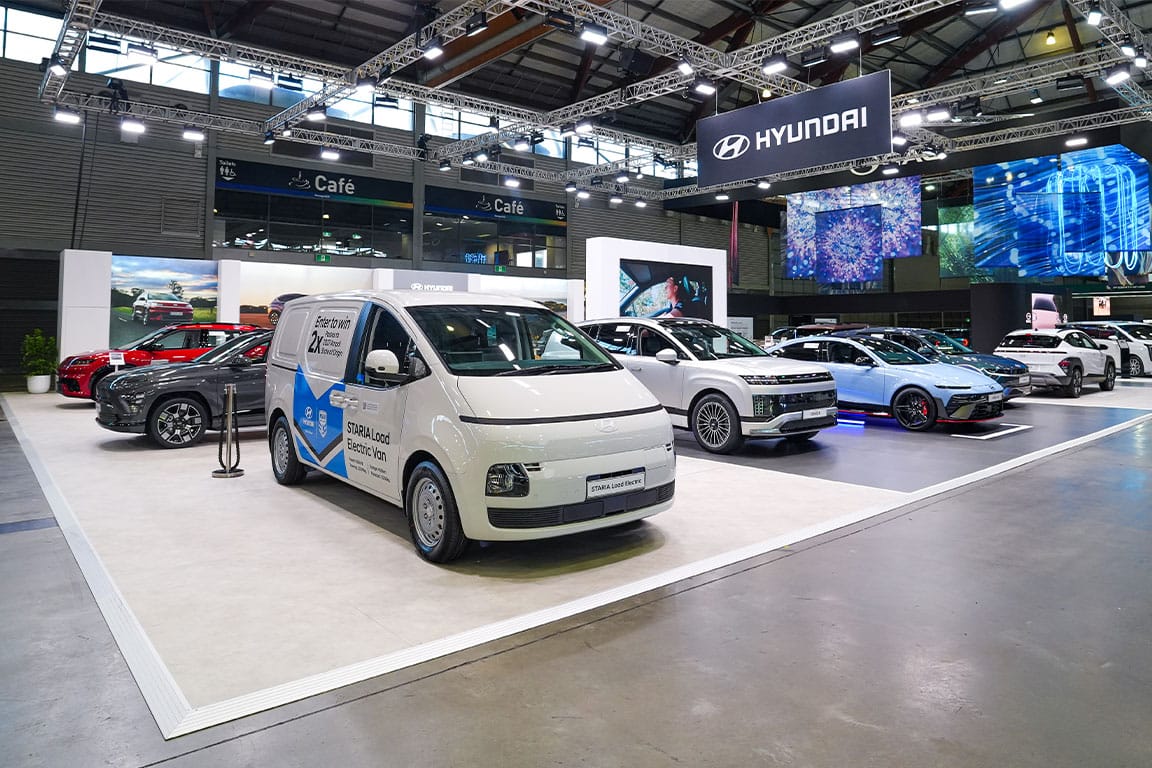 Hyundai’s stand at the 2026 Everything Electric festival, hosted at the Sydney Showground.
Hyundai helping hands were also present to answer attendees’ questions about everything from real-world range and daily running costs to vehicle-to-grid (V2G) charging. This emerging EV technology – which, at the time of writing, is not supported by any Hyundai vehicles in Australia – essentially transforms a compatible EV into a “battery on wheels”. One that can draw power from the grid, power an owner’s home and even feed electricity back into the network to help balance demand and reduce energy costs.
Among those fielding the questions was Scott Nargar, Senior Manager Future Mobility & Government Relations at Hyundai Motor Company Australia, who said that his discussions at the event reflected an evolving fluency in Australian consumers.
“The increasing sophistication of consumer questions at events such as Everything Electric demonstrates how rapidly the Australian market is maturing,” Nargar says. “Australians are becoming increasingly informed on – and confident about – EV technology. Conversations have shifted beyond basic questions about range and charging to more complex topics such as V2G integration, smart charging, battery technology, aftersales support and total cost of ownership.”
The very perception of what an EV is seems to be evolving, too, with more people thinking outside of the box when it comes to getting the most out of their so-called “battery on wheels”.
“Customers are increasingly seeing EVs as more than just transport,” Nargar explains. “They view them as a connected part of their home and energy management strategy. They are looking for vehicles that integrate seamlessly with their homes, energy providers and everyday lifestyles.”
According to Nargar, these consumers are looking for EVs that ultimately deliver three key outcomes: 1) usability, 2) affordability and 3) reliability.
In practical terms, that means 1) real-world driving range, fast-charging capability and advanced safety technologies, 2) competitive pricing and 3) strong aftersales support, respectively.
Just as vital, however, is peace of mind. Nargar emphasises that consumers are also looking for a trusted brand capable of supporting their entire ownership journey – from purchase and servicing to home charging solutions and future software updates.
In other words, they’re looking for a Hyundai EV.
 The 2026 IONIQ 6 N, the most powerful all-electric Hyundai vehicle ever made.
An EV for almost everyone.
So what is Hyundai Motor Company of Australia (HMCA) doing to support these ever-changing – and ever-expanding – needs of consumers? In short, a lot.
2026 has been a busy year at HMCA HQ. One of its busiest ever, in fact. It marked the celebration of not one, but two major milestones for Hyundai: 40 years operating in Australia, and 35 years developing electric vehicles.
But it’s not all cake and candles. In the span of just nine months, HMCA has launched six electrified vehicles – specifically three BEVs (the ELEXIO, IONIQ 6 N and STARIA Load Electric) and three hybrids (the PALISADE, STARIA Load and STARIA Lounge). As a result, Hyundai now offers the broadest EV range of any automotive brand in Australia, spanning everything from small city cars to mid-sized SUVs and large commercial vans – even high-performance vehicles. There is, as Nargar puts it, “an EV for almost everyone.”
But beyond expanding its portfolio of award-winning vehicles, the brand has been – and continues to be – the driving force of EV innovation in Australia.
“Hyundai's vision extends beyond manufacturing vehicles,” Nargar says. “It continues to invest heavily in electrification, connected vehicle technologies and energy integration. In Australia, we are actively working with industry partners, energy retailers, network operators and government stakeholders to support the development of V2G and smart charging solutions, and we continue to enhance charging experiences through ongoing technological development and customer education programs.”
Through these efforts, the brand is transforming a short-term car purchase into a long-term energy investment – ensuring that every Hyundai EV works just as hard for its owner while parked in the driveway as it does on the road.”
Leading the charge .
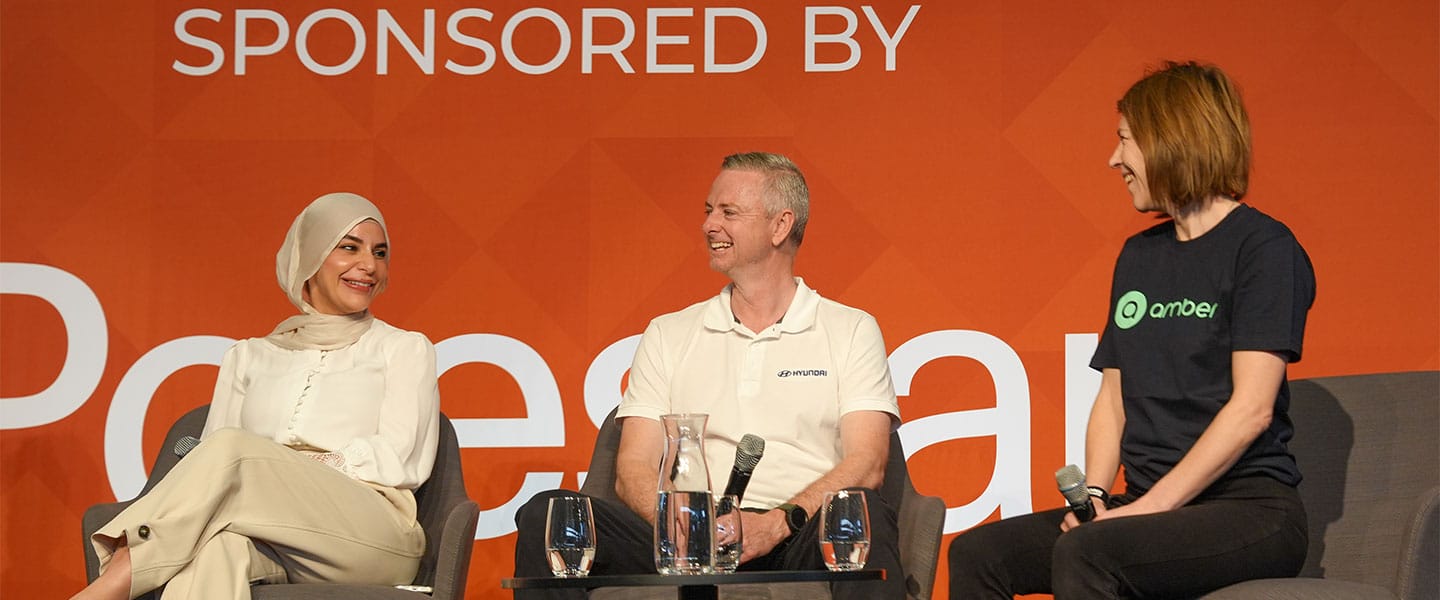
Scott Nargar speaking at the 2026 Everything Electric event in Sydney.
But Nargar is eager to point out that the future of EVs is even more electrifying. The brand’s sights are firmly set on the horizon, with even more models on the way and a network of smart energy solutions that’s rapidly expanding.
“As the market evolves, we will continue to expand our EV portfolio and enhance charging experiences through ongoing technological development and customer education programs,” he says. “We will also continue working closely with industry, governments, media and energy sector partners to unlock new opportunities for electrified sustainable mobility.”
“We see the future of mobility as connected, electrified and integrated with Australia's broader energy ecosystem,” he continues. “Our role is to help drive that transition by delivering innovative vehicles and supporting new technologies such as V2G, as well as collaborating with industry partners and ensuring customers have the confidence and infrastructure needed to embrace electrification.
“Australia's mobility future will be shaped by collaboration, innovation and customer choice – and Hyundai is committed to being at the forefront of that journey.”
With sales hitting all-time highs, attendance figures at events like Everything Electric breaking records and electric vehicle adoption accelerating swiftly, the message from Australians is loud and clear.
EVs are no longer just the future – they’re also the present. And, as Nargar notes, after dedicating the past 35 years – and counting – to making that future a present-day reality, one that every Australian stands to benefit from, whether it’s using an EV to help lower running costs, power the grid or contribute o a cleaner, more sustainable environment for not just the country, but the entire world, Hyundai is firmly in the driver’s seat. And prouder than ever to be leading the charge.
FAQs.
-
Everything Electric is a major global festival of electrification and clean energy, originally founded by Robert Llewellyn, known from the YouTube channel Fully Charged and the British TV comedy Red Dwarf. While it serves as a large showcase for electric vehicles (EVs) of all shapes and sizes – from e-bikes and scooters to cars and electric trucks – it is not strictly an automotive show. The expo also focuses heavily on home energy and clean tech solutions – such as solar, wind and battery storage – with the overarching educational goal of encouraging people to transition to renewable energy. In 2026, the Australian edition was held at Sydney Olympic Park on 18–20 September, drawing record crowds of over 37,000 visitors.
Hyundai used the 2026 Everything Electric Sydney show as a major platform to connect with both everyday consumers and commercial businesses, such as tradies and fleet operators. Their attendance was driven by a few key highlights: namely, debuting the STARIA Load Electric for the first time in Australia, showcasing three of its award-winners from World Electric Vehicle of the Year – the IONIQ 5, IONIQ 6 and INSTER – presenting its newest high-performance all-electric vehicle – the IONIQ 6 N – and speaking with hosts and guests alike about a range of EV topics, from running costs to vehicle-to-grid (V2G) technology.
-
V2G is an emerging technology that enables an EV to send electricity from its battery back to the grid or a home, helping manage energy use and support the electricity system. At the time of writing, Hyundai neither supports nor permits V2G charging of any Hyundai EVs in Australia, however it is supporting its development, as demonstrated not only by the brand’s assistance with the launch of V2G in the US, the Netherlands and Korea, but also its ongoing collaboration with Australian research organisations in Australia.
Because V2G is still being developed and tested, the timing of its availability will depend on technology readiness, regulations and energy market conditions. Hyundai will share updates as they become available.
-
In theory, EV owners will be able to use bidirectional chargers to:
feed their EV’s electrical energy into the grid during peak periods – known as V2G charging – to help balance grid demand, reduce reliance on fossil fuels and earn passive income.
feed their EV’s electrical energy into the home – a process called vehicle-to-home or V2H charging – to help power their property and reduce their household energy costs;
and feed the grid’s electrical energy into their EV grid during off-peak periods – known as grid-to-vehicle or G2V charging – to charge their vehicle, at a lower cost, using renewable energy.
It’s important to note that this will need to be done in strict accordance with any applicable laws, regulations and guidelines – and only when it’s safe to do so. Bidirectional charging is an emerging technology, and at the time of writing, is not safe to use with Hyundai EVs in Australia. Hyundai will share updates as they become available.
To learn more about bidirectional charging, click here.
-
As well as offering the broadest EV range of any automotive brand in Australia, Hyundai is investing heavily not only in the country’s transition to EVs, but also its energy integration and connected vehicle technologies.
Through collaboration with industry partners, energy retailers, network operators and government stakeholders, the brand is actively supporting the growth of V2G and smart charging solutions, all while continuing to elevate charging experiences through ongoing technological developments and customer education programs.
-
Despite EVs hitting a record 17% market share in Australia in early 2026, some industry experts have indicated that there are still primary barriers to faster adoption – namely infrastructure reliability, policy confusion and widespread misconceptions.
A 2026 government inquiry into EV myths concluded that adoption is being stalled more by outdated perceptions than actual capability, and this has been echoed in other research. A 2026 Changing Gears report found that 56% of Australians still remain concerned about EV fire risks, despite data showing that these incidents are exceedingly rare. It also observed that 60% of consumers who refuse to consider an EV cite battery life as a primary barrier, even though many modern EV batteries are designed to last 15 to 20 years – often outliving the chassis of the vehicle itself.
Although misconceptions like these are stalling faster adoption, they’re expected to erode over time. It’s not a case of if, but when.
To learn more about the most common EV myths in Australia, read our guide here.