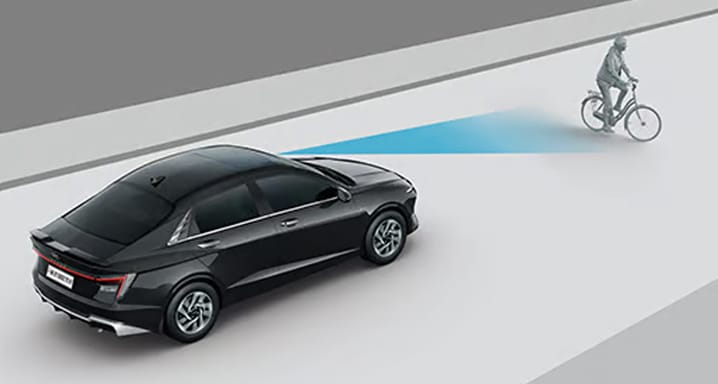
Hyundai VERNA 2026 Safety: Intelligent Protection with Hyundai SmartSense
Published: March 16, 2026
The new Hyundai VERNA prioritises safety through a strong body structure and intelligent driver assistance technologies. Built with robust safety at its core for modern Indian roads, it is engineered to protect what matters most while enhancing awareness, control and timely intervention in varied traffic conditions. Equipped with Level 2 Advanced Driver Assistance Systems and 6 airbags as standard, the VERNA delivers comprehensive occupant protection. Electronic stability features across variants further strengthen control during challenging situations. By combining thoughtful prevention systems with strong passive fundamentals, the Hyundai VERNA ensures peace of mind and supports confident, secure and composed driving every day, whether in city traffic or on long highway journeys.
Table Of Contents
Level 2 ADAS: The Future of Collision Avoidance
The new Hyundai VERNA is equipped with Level 2 Advanced Driver Assistance Systems in select variants. These advanced systems work together through a network of cameras and sensors that continuously scan the vehicle’s surroundings. By assessing road conditions, traffic movement and potential obstacles, they enhance awareness and control, helping the driver identify hazards early.
Rather than replacing driver control, ADAS supports moving smarter and safer by enhancing reaction time and situational awareness. It delivers timely visual and audible alerts and, in certain situations, can initiate corrective measures such as controlled braking or steering assistance. This balanced approach ensures that the driver remains in command while benefiting from intelligent technological support. On busy Indian roads, where unpredictability is common, such systems provide meaningful reassurance.
Forward Collision-Avoidance Assist (FCA): Car, Pedestrian, and Junction Turning
Forward Collision-Avoidance Assist detects vehicles, pedestrians and cyclists ahead using advanced sensors that monitor distance and speed. If a potential collision is identified, the system alerts the driver, allowing time to respond. Should the driver fail to react, it can apply braking support to reduce the risk of impact or its severity. This is especially useful in heavy urban traffic with sudden stops and crossings. The Junction Turning function further enhances protection by detecting oncoming vehicles while turning right at intersections, providing braking assistance when required to help manoeuvre safely in challenging city conditions.
Blind-Spot Collision-Avoidance Assist (BCA) and Rear Cross-Traffic Help
Blind-Spot Collision-Avoidance Assist monitors areas that are difficult to see through conventional mirrors. When another vehicle enters the blind spot, the system alerts the driver with a warning signal. In certain conditions, it can also apply selective braking to discourage unsafe lane changes.
This feature is particularly helpful during highway driving, where vehicles may approach quickly from adjacent lanes. By improving awareness of surrounding traffic, it supports more confident and informed lane transitions.
Rear Cross-Traffic Collision-Avoidance Assist (RCCA) supports the driver while reversing. If vehicles approach from either side while backing out of a parking space, the system provides an alert and may apply braking assistance if necessary. In crowded parking areas and residential zones, where visibility is often restricted, this function adds an extra layer of protection.
Related Read: Hyundai VERNA 2026 Is Here: A Bold New Era of Premium Sedans
Lane Management and Driver Awareness Systems
Maintaining lane discipline and staying attentive behind the wheel are essential aspects of safe driving. The new Hyundai VERNA integrates multiple systems to support lane positioning and monitor driver behaviour, especially during extended journeys.
Lane Keeping Assist (LKA) and Lane Following Assist (LFA)
Lane Keeping Assist detects road lane markings and provides steering input if the vehicle begins to drift unintentionally. This helps reduce the likelihood of accidental lane departure, particularly at higher speeds.
Lane Following Assist builds on this capability by helping keep the vehicle centred within its lane. It works continuously while driving on marked roads, offering subtle steering corrections to maintain alignment. Together, these features enhance stability and reduce driver strain during long highway trips, contributing to a more composed driving experience.
Driver Attention Warning (DAW) and Safe Exit Warning (SEW)
Driver Attention Warning monitors steering patterns and overall driving behaviour. If it detects signs of fatigue or reduced attentiveness, the system alerts the driver to consider taking a break. This feature encourages responsible driving habits, especially on long-distance routes.
Safe Exit Warning enhances passenger safety. When a vehicle approaches from behind, the system issues a warning before occupants open the door. In busy urban settings where two-wheelers and cars frequently pass parked vehicles, this feature provides additional awareness and caution.
Standardised Protection: The 35 Standard Safety Features
Safety in the new Hyundai VERNA extends beyond its advanced systems. A broad range of essential protective features is standard across the line-up. With 35 standard safety features , the vehicle ensures that core protection is available to every customer, regardless of variant.
This consistent approach reflects a commitment to accessible safety. It reinforces the idea that protection should not be limited to top trims but integrated throughout the range.
6 Airbags Across Every Single Variant
The VERNA comes equipped with 6 airbags as standard across all variants. These include driver and passenger airbags, side airbags and curtain airbags . Together, they provide comprehensive coverage in the event of a collision.
Higher variants also offer a centre side airbag, designed to provide additional protection during side impacts by reducing potential contact between front occupants. This extensive airbag coverage enhances occupant safety for both front and rear passengers, underscoring the focus on holistic protection.
Structural Integrity: ESC, VSM, and Hill-Start Assist Control
Electronic Stability Control (ESC) plays a vital role in maintaining vehicle balance during sudden manoeuvres or on slippery roads. If instability is detected, it adjusts engine power and selectively applies braking to individual wheels, helping the driver maintain directional control.
Vehicle Stability Management (VSM) works in coordination with ESC, supporting overall stability by harmonising steering and braking inputs. These systems are especially useful during emergency avoidance situations or when driving on uneven surfaces.
Hill-Start Assist Control (HAC) prevents the vehicle from rolling backwards when moving off on an incline. This feature is particularly helpful in hilly areas and multi-level parking spaces, enabling smoother and more confident starts.
Together, these structural and electronic systems enhance control and reinforce the vehicle’s active safety foundation.
Also Read: Hyundai VERNA 2026 Performance: Turbo Power with Effortless Control
Smart Surveillance: Dashcam with Dual Camera and Surround View Monitor
Select variants of the new Hyundai VERNA feature an integrated dashcam that records the road ahead and behind the vehicle. This system provides added documentation and monitoring support during every drive. In unexpected situations, the recorded footage can serve as a useful reference.
The Surround View Monitor provides a 360-degree perspective of the vehicle’s surroundings. By displaying a composite overhead view on the infotainment screen, it assists the driver in tight parking spaces and low-speed manoeuvres.
Blind-Spot View Monitor (BVM) further improves visibility by showing real-time footage of the blind spot when the turn indicator is activated. These intelligent surveillance features work together to enhance awareness and promote safer decision-making in everyday driving.
Conclusion
The Hyundai VERNA 2026 combines structural strength, advanced airbag protection and intelligent driver-assistance technologies to deliver comprehensive safety.
With Level 2 ADAS features such as Forward Collision - Avoidance Assist - Car (FCA-Car), Blind-Spot Collision-Avoidance Assist (BCA) and Lane Following Assist (LFA), along with 6 standard airbags and electronic stability systems , the vehicle supports both prevention and protection.
For drivers seeking a sedan that prioritises safety while seamlessly integrating modern technology, the new Hyundai VERNA offers a thoughtfully engineered solution tailored to Indian driving conditions.
Ready to experience safety designed for modern roads? Discover the new Hyundai VERNA and explore how Hyundai SmartSense, Level 2 ADAS technologies and comprehensive airbag protection work together to enhance awareness and support confident driving. Visit your nearest Hyundai showroom or schedule a test drive online to see how its intelligent safety systems operate in real-world conditions.
Drive with confidence in the new Hyundai VERNA today.