Vehicle-to-Grid (V2G) Explained:
What V2G Means for EV Owners
Vehicle-to-Grid (V2G) Explained: How EVs Can Help Power the Grid
Vehicle-to-Grid technology has generated a lot of buzz in recent years, with new pilot programs, commercial trials and progressive initiatives launching in countries all over the world – including Australia.
But what is “V2G”, exactly? And can a vehicle-to-grid charger be used with Hyundai electric vehicles? Here to answer your questions is Scott Nargar, Senior Manager of Future Mobility & Government Relations at Hyundai Motor Company of Australia.
What is V2G technology?
Vehicle-to-grid (V2G) is a bidirectional charging system that can enable the flow of electrical energy from electric vehicles (EVs) to a power grid, and vice versa.
By using a bidirectional EV charger, an owner of a compatible, V2G-enabled EV can essentially transform it into a “battery on wheels”; one that can not only be charged by the grid but also used to charge the grid itself – and the owner’s home.
This raises some exciting benefits, as well as a crucial question…
Can I use V2G chargers with Hyundai vehicles in Australia?
“Hyundai vehicles do not support V2G charging in Australia,” says Scott Nargar, Senior Manager of Future Mobility & Government Relations at Hyundai Motor Company of Australia. “We want customers to understand that using unapproved V2G chargers with Hyundai EVs poses a risk to their safety, their vehicle and their vehicle’s warranties.”
“Hyundai is, however, supporting the development of V2G technology, as demonstrated not only by the brand’s assistance with the launch of V2G in the US, the Netherlands and Korea, but also the work we’re doing here in Australia.

Scott Nargar, Senior Manager of Future Mobility & Government Relations at Hyundai Motor Company of Australia.
“We’re working with Australian research organisations to test V2G technology, to test charging systems, to test EVs. And we’re working on the standards and regulations regarding the safe export of energy from EVs, through chargers and into the home or grid.
“Hyundai is also the only original equipment manufacturer (OEM) in Australia currently taking part in the Vehicle-Grid Network (VGN) funded by the federal government and the Australian Renewable Energy Agency (ARENA). We’re committed to its development”
“That said, we neither support nor permit V2G charging of any Hyundai EVs in Australia at this time.”
Is V2G a new technology?
Although it’s been making waves recently, V2G is not a “new technology”, exactly; its formal framework was actually invented in 1997 by Doctor Willett Kempton and economist Steven Letendre at the University of Delaware in the United States, with the first practical trials held in 2007.
Since then, dozens of V2G pilot programs have been launched worldwide, including one recently held in Australia by energy provider Amber Electric. But while the technology has technically existed in various forms for more than 25 years, it’s only just starting to move out of the experimental trial phase.
V2G is, therefore, not so much a new technology as an emerging technology, and like any emerging technology, it presents its own unique set of challenges – and benefits.
What are the benefits of V2G technology for EV owners?
The potential benefits of V2G charging are considerable, provided that it’s done safely and in strict accordance with any applicable laws, regulations and guidelines.
By using bidirectional chargers, EV owners can:
- feed their EV’s electrical energy into the grid during peak periods – V2G charging – to help balance grid demand, reduce reliance on fossil fuels and even earn passive income.
- feed their EV’s electrical energy into the home – a process called vehicle-to-home or V2H charging – to help power their property and reduce their household energy costs;
- feed the grid’s electrical energy into their EV grid during off-peak periods – known as grid-to-vehicle or G2V charging – to charge their vehicle, at a lower cost, using renewable energy.
And, as Scott points out, there are environmental benefits, too. During off-peak periods when power demand is low, the grid mostly operates using renewable energy sources – solar energy, wind energy, etc. So by using an EV to absorb that clean surplus energy and feed it back into the grid during peak periods, the reliance on carbon-intensive fossil fuel "peaker" plants can be reduced significantly.
“V2G technology presents a great opportunity as the world switches from fossil fuels to renewable energy," Scott says, “And EVs play a key role in that: they can help support the grid during peak periods, when demand is high, and then be recharged during off-peak periods, when demand is low, all while using clean, low-cost energy. It’s exciting stuff.”
How does V2G work?
V2G works using three key components:
1. an EV
2. a bidirectional charger
3. the power grid
Here’s what the flow of electrical energy looks like between these components, first via V2G, then Grid-to-Vehicle (G2V).
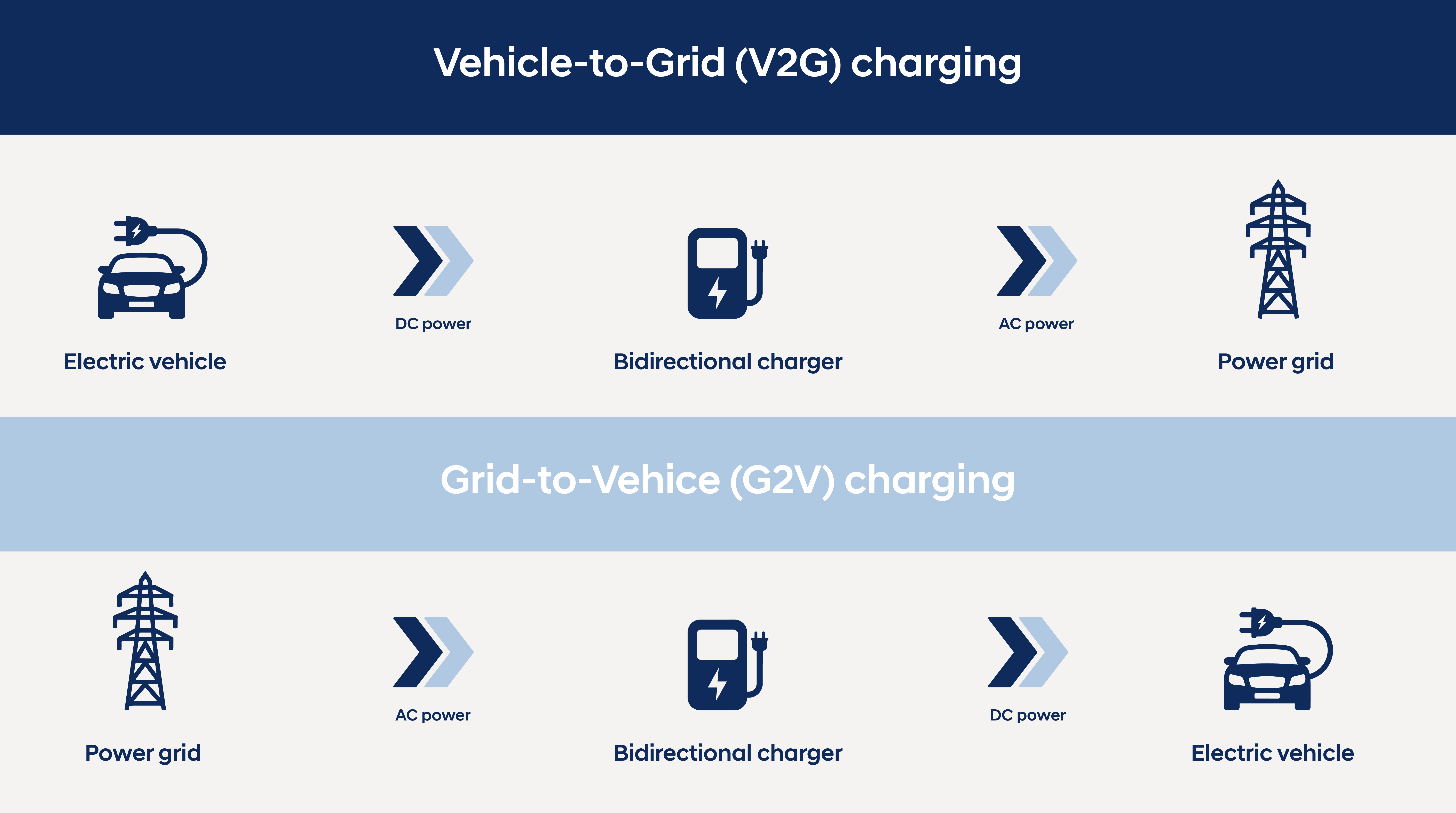
A diagram depicting the flow of electrical energy through both V2G and G2V charging.
And here’s how V2G works in seven simple steps, using an everyday example.
1. An EV owner plugs their V2G charger into their V2G-enabled car, opens a V2G charging app on their smartphone and selects their charging requirements – for example, their EV needs at least 80% battery by 7:00 AM the following day (for, say, their commute), but any remaining charge can be sent to the grid overnight.
2. The V2G charger and EV perform a “digital handshake”; the car identifies itself to the grid, and the grid receives essential data from the car, such as the battery’s charge and temperature. This is done using a universal communication standard called ISO 15118.
3. The V2G charger communicates with what’s called an aggregator – i.e. a cloudbased software platform run by an energy company – which monitors the electrical grid in real time. It assesses two things: grid demand and electricity prices.
4. During a peak period when demand and prices have risen – at 7:00 pm, for example, when lots of people return home and start turning on electrical appliances like TVs, ACs, etc. – the grid sends a signal to the aggregator that more power is required.
5. To prevent a utility provider from firing up a coal or gas peaker plant, the aggregator passes on that signal to the V2G charger, which then pulls direct current (DC) electricity out of the EV’s battery, transforms it into alternating current (AC) – the type used by homes and the grid – and sends it to one of two places. Either a) to the owner’s home to help power the property, or b) through the owner’s home and into the grid. In the latter instance, the utility provider then credits the EV owner’s energy account as their vehicle has just helped to stabilise the grid when demand was high.
6. Hours later during an off-peak period, when both electricity demand and prices have fallen – for example at 02:00 am, when most people are asleep and their electricity usage has declined – renewable energy farms start producing excess energy. Detecting this excess, the aggregator sends the inverse signal to the charger; that more power is no longer required by the grid, and that the EV should use this renewable energy to recharge.
7. The opposite process begins; vehicle-to-grid charging reverses to grid-to-vehicle (G2V) charging. The charger pulls the cheap, clean AC energy from the grid, converts it back to DC and sends it to the EV’s battery so it can charge to 80% by 07:00 AM, as requested – this time at a fraction of the cost compared to charging in a peak period.
So, to recap: using the above example, the EV owner has charged their EV using the grid, their home using their EV and the grid using their EV. That’s why it’s called a bidirectional EV charger – it employs a two-way exchange of electrical energy.
Plus, not only have they charged their EV using renewable energy, and at a lower cost; they’ve also earned some passive income and helped their fellow Australians by reducing strain on the grid. Everyone wins.
So what’s the catch? And if it’s so simple, why isn’t every EV owner using V2G chargers already?

Hyundai EVs on the road ahead.
What are the challenges and limitations of V2G charging?
The fact of the matter is, V2G technology is still in development. And before it can be used safely with Hyundai EVs, there are some inherent obstacles that need to be surmounted – one in particular.
Scott says that, for Hyundai, safety comes first – always.
“We want to see the safe operation of V2G technology across all manufacturers,” he says, “and not just automotive manufacturers; we want to see the same level of safety for all V2G chargers being imported into Australia. We want to make sure that there’s a robust testing and certification system put in place to ensure a great customer experience, with reliable V2G chargers delivering energy safely.
“Currently, though, V2G charging is not ready here in Australia. We have different requirements, different technology. So more testing is required before its safety can be assured.”
The signs are positive that, for Australians, V2G charging of EVs is not so much a case of if as when. But until that happens, it’s best to err on the side of caution and leave the experimental tech where it belongs: in the hands of the experts.
Interested in our award-winning range of EVs? Click the link below to find out more.
FAQs
-
Vehicle-to-Grid (V2G) is an emerging technology that allows an electric vehicle to send electricity from its battery back to the grid or a home, helping manage energy use and support the electricity system.
-
No. Currently, there are no Hyundai vehicles in Australia that support V2G.
-
No, you cannot use V2G bidirectional charging on any Hyundai vehicles in Australia at this time. While the technology is an exciting advancement for the energy industry, we do not currently support or permit V2G charging. The use of unapproved bidirectional charging equipment introduces safety risks, potential vehicle damage and warranty implications for your vehicle.
-
V2G is still being developed and tested. Timing will depend on technology readiness, regulations, and energy market conditions. Hyundai will share updates as they become available.